
Jun 5, 2026
In this Article:
● Family group chats are now a primary space where teens practice everyday communication skills.
● They influence tone, speed, and emotional expression in ways that extend beyond messaging apps.
● Many teens develop “always-on” social expectations that can increase pressure and distraction.
● Parents are increasingly visible participants in teen digital social life through shared messaging spaces.

Estimated Reading Time: 12 minutes┃Post By Dr. Elaine Mercer
Family group chats are no longer just a convenience feature for coordinating dinner plans or sharing vacation photos. For many households, they have become the default communication layer between parents, teens, siblings, and even extended relatives. In these shared digital spaces, teenagers are learning—often unconsciously—how to speak, respond, negotiate, and manage social identity in real time.
What used to happen in private peer-only channels now unfolds in hybrid spaces where parents, siblings, and sometimes grandparents observe the same conversations. This shift is subtle, but its effects are structurally changing how teens communicate both online and offline.
A recent synthesis of adolescent communication research shows that digital family interaction patterns can directly shape adolescents’ broader technology use and emotional regulation, especially when communication is frequent and emotionally charged . At the same time, group messaging has become one of the most common daily communication modes for teens, often serving as both a social hub and emotional support system .
To understand what is actually changing, it helps to move beyond abstract claims and examine how these chats function inside real households.
The New Household Communication Layer
In many families today, the group chat has replaced what used to be fragmented communication. Instead of one-on-one texting between parent and teen, families now often rely on multi-person, continuous threads. Scheduled updates, such as reminders at the dinner table or brief phone calls, have been replaced by constant asynchronous messages. Parents no longer have to check in directly; they have passive visibility into teen life. Similarly, sibling communication, once separate and private, now occurs in the same shared environment alongside parents.
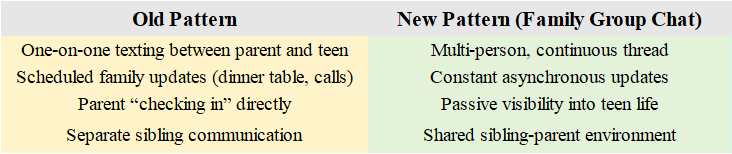
What appears trivial is actually important: teens are learning that communication is non-linear, public within the family, and continuously monitored.
This environment normalizes fragmented attention patterns and rapid shifts between emotional tones—skills that carry into peer group chats.
Teens Learn “Tone Calibration” Earlier Than Previous Generations
One of the most significant behavioral changes is not what teens say, but how they adjust how they say it depending on the audience. In mixed family group chats, teens often develop strategies such as substituting emojis for emotional nuance, using short-form replies to avoid overexposure, using humor as a deflection strategy, and maintaining selective silence to manage perceived scrutiny.
A 15-year-old in a documented household study described it informally as:
“I type differently when my mom is there. I don’t want to explain everything.”
This aligns with broader findings that parent-adolescent communication patterns influence how teens regulate emotional expression and disclosure online .
Example: Message adaptation across contexts

The same experience is linguistically compressed or expanded depending on perceived authority presence.
Over time, this produces what communication researchers sometimes describe as audience stratification: teens internalize multiple communication “registers” and switch between them fluidly.
The Rise of “Ambient Parenting”
Family group chats have introduced a new dynamic: parents are no longer just active communicators—they are ambient observers.
Unlike traditional check-ins, group chats allow parents to:
See peer-like interactions between siblings
Monitor emotional tone indirectly
Respond without initiating direct confrontation
Participate selectively without fully entering teen social spaces
This creates a hybrid environment where teens feel both independent and observed.
A widely reported pattern is “soft supervision”—parents do not intervene immediately but remain present in the background of communication streams.

This delayed-response model reduces immediate conflict but increases awareness of surveillance, which can subtly affect how openly teens express distress.
Group Chats as Emotional Infrastructure
Research consistently shows that group messaging can increase perceived social support, especially among adolescents who use it frequently (sciencedirect.com). In family contexts, this translates into group chats functioning as micro-support systems, daily emotional check-in points, low-effort coordination tools, and shared memory archives.
However, these chats also introduce emotional complexity. On the positive side, they provide instant reassurance, shared humor, coordination efficiency, and emotional visibility. On the negative side, they create pressure to respond quickly, increase the risk of misinterpreted tone, lead to notification fatigue, and make teens feel constantly “watched.” One teen described it this way: “It’s nice, but I also feel like I can’t fully disappear even when I want to.” This “always reachable” expectation is one of the most notable psychological shifts compared to pre-smartphone family communication norms.
The Spillover Effect Into Peer Communication
Family group chats do not remain isolated environments. They actively shape how teens behave in peer spaces.
Observed spillover behaviors:
Faster response expectations in friend groups
Increased use of emojis as emotional shorthand
Reduced tolerance for delayed replies

Normalization of multi-thread conversations
Increased comfort with “broadcast messaging” rather than direct conversation
In essence, family chats serve as training environments for broader digital communication norms.
However, peer group chats often operate under different emotional rules (status, exclusion, humor hierarchies), which can create friction when habits transfer too directly.
When Group Chats Improve Family Cohesion
Despite the challenges, family group chats often play a significant role in strengthening family relationships. By keeping everyone connected throughout the day, these chats allow family members who are physically apart to share moments, updates, and even humor, creating a sense of closeness that was harder to maintain in pre-digital households.
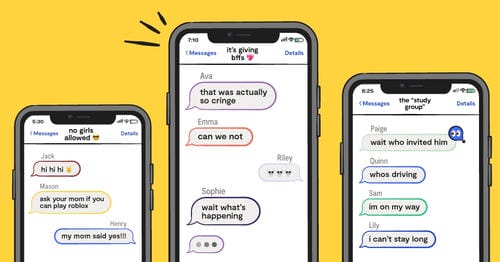
They also streamline daily coordination, reducing misunderstandings about schedules, appointments, or responsibilities. Instead of repeated verbal reminders, one simple pinned message can keep everyone informed, and shared calendars or reminders within the chat can prevent forgotten plans. In addition, family group chats can provide a space for lighthearted interaction—memes, jokes, and quick check-ins—which can enhance bonding without demanding face-to-face time. Overall, when used thoughtfully, these chats can reduce friction, improve accountability, and create a continuous thread of connection that supports overall family cohesion.
The Long-Term Communication Shift
Over time, the prevalence of family group chats contributes to lasting changes in how teens and families communicate. Communication is becoming more continuous and less episodic, with small interactions occurring throughout the day rather than limited to scheduled conversations. Teens are learning to express emotions in more compressed, symbolic ways, using emojis, GIFs, and short phrases to convey tone efficiently. At the same time, audiences are increasingly mixed; a single message may be read by parents, siblings, and extended family simultaneously, requiring teens to adjust their communication style depending on who is present. Response speed has also gained social significance, and the choice to remain silent in a group chat can carry meaning as much as any reply. Collectively, these shifts represent a structural transformation in adolescent communication, reshaping social norms, expectations, and skills in both digital and offline spaces.
(This article is intended for informational and educational purposes only. It does not constitute psychological, medical, or clinical advice. Observations are based on aggregated research findings and illustrative scenarios intended to reflect common family communication patterns in digital environments.)
FQAs
1. Are family group chats harmful for teenagers?
Not inherently. They can improve coordination and connection, but excessive pressure to respond or constant monitoring can contribute to stress in some adolescents.
2. Do family group chats replace face-to-face communication?
They usually supplement rather than replace it, but in some households they reduce the frequency of phone calls and in-person check-ins.
3. How can parents make group chats healthier for teens?
Setting expectations about response times, avoiding excessive messaging, and respecting offline boundaries can help maintain balance.
About the Author
Dr. Elaine Mercer is a developmental communication researcher specializing in adolescent digital behavior and family systems. Her work focuses on how emerging communication technologies reshape interpersonal dynamics within households, particularly among teenagers navigating hybrid online-offline social environments.
References
Faverio, M., Park, E., & Gottfried, J. (2026). Teens’ experiences on TikTok, Instagram and Snapchat. Pew Research Center.
Luo, F., Du, Y., Sun, Q., Peng, N., et al. (2026). Family functioning and mobile phone dependency among adolescents. BMC Psychology.
Su, Z., Lin, L., Li, Z., & Ding, R. (2026). Bidirectional relationships between family communication patterns and adolescent technology use. Journal of Adolescence.
Afifi, T. D., & Edwards, A. L. (2026). Balancing face-to-face and digital communication in families. Journal of Family Communication.
Stay on this blog to explore more insights into how digital habits are reshaping modern family life.