
May 31, 2026
Key Takeaways:
● Children often arrive home mentally exhausted even if they look fine at school.
● Many kids need a short “buffer period” before they can talk about their day.
● This decompression time helps reset their nervous system after sustained self-control.
● Immediate questioning or demands can trigger shutdowns or meltdowns.
● Simple routines like snacks, quiet play, and low-pressure space improve transitions.

Estimated Reading Time: 9 minutes┃Post By Claire W. Hensley
A child drops their backpack by the door, kicks off their shoes without a word, and walks straight to the couch. You ask, “How was school?” The answer is a shrug, a blank stare, or a flat “fine.” Five minutes later, the same child might suddenly cry over a missing pencil, argue about homework, or snap at a sibling for no obvious reason.
This pattern is not random. It reflects a predictable post-school transition state often described in child psychology as after-school restraint collapse—a temporary loss of emotional regulation after a full day of self-control, sensory input, and social effort . During school hours, children must continuously regulate behavior: sitting still, following instructions, interpreting social cues, and suppressing impulses. When they arrive home, that effort stops, but the nervous system does not immediately reset.
What looks like “not wanting to talk” is often the opposite: the brain is temporarily unable to organize language, memory, and emotion into coherent narrative. This is why many children need a structured decompression window before conversation becomes possible.

Why School Drains More Than We Realize
From an adult perspective, school may look structured and predictable. From a child’s nervous system perspective, it is a sustained performance environment.
During a typical school day, a child may be required to:
● Maintain attention for 4–6 hours
● Filter noise, movement, and peer interaction
● Comply with frequent transitions
● Manage performance expectations (academic and social)
● Suppress emotional reactions in real time
Even for well-regulated children, this produces cumulative cognitive and emotional fatigue. Studies on after-school behavior describe this as mental depletion, where executive function resources are temporarily exhausted by sustained self-regulation demands .
By the time school ends, many children are not “refusing to talk.” They are simply operating on low cognitive bandwidth.

The Nervous System Reset: What Decompression Is Doing
A useful way to understand decompression time is through the lens of state transition:
● School state: high regulation, high inhibition, high stimulation
● Home arrival state: low regulation capacity, high emotional leakage
● Decompression state: gradual return to baseline
When children arrive home, their nervous system shifts from controlled performance to safety response. This is why emotional release often happens at home rather than at school. It is not misbehavior—it is physiological offloading.
During this window, children may exhibit:
● Silence or monosyllabic answers
● Increased need for physical comfort or space
● Irritability over small triggers
● Apparent “forgetfulness” or disorganization
● Sudden emotional reactions
These are not separate problems; they are expressions of a system recalibrating.
What Decompression Time Actually Looks Like in Real Homes
Decompression time is not a formal intervention. It is what happens when a child is allowed to shift from external demands to internal regulation without pressure.
Consider three typical after-school patterns:
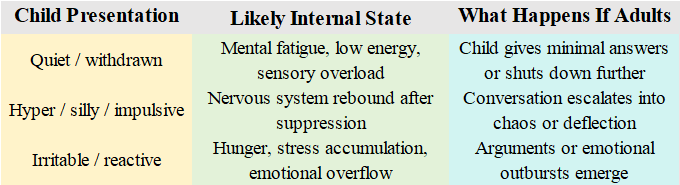
In each case, the behavior is not about defiance. It reflects regulation failure in transition. Research and clinical guidance consistently emphasize that children often “hold it together” during school and release accumulated stress at home, where they feel safe enough to decompress .
What Effective Decompression Looks Like in Practice
Decompression works best when it is predictable, low-demand, and sensory-supportive. The goal is not entertainment—it is regulation.
1. The “No Questions First” Window (10–30 minutes)
In many households, the most effective shift is simply delaying verbal demands. During this window:
● No school-related questions
● No correction or instruction
● No immediate homework pressure
Instead, allow parallel presence: the child exists near adults without needing to perform socially.
2. Physiological Stabilizers
After school, basic biological needs strongly influence behavior:

These are not “extras.” They are foundational regulation inputs.
3. Sensory Downshifting
Many children move from high sensory input environments (noisy classrooms, bright lighting, social density) into home environments that feel comparatively neutral. Without transition support, the nervous system can remain “stuck on high alert.”
Helpful decompression inputs include:
● Dim lighting
● Soft clothing changes
● Quiet background sound
● Familiar repetitive activities (drawing, Lego, coloring)
These create predictability, which signals safety to the brain.
A Common Misstep: Immediate Questioning
One of the most common parenting reflexes is also one of the least effective in this moment: “How was your day?”
It seems harmless, even caring. But for a child whose cognitive resources are depleted, this question can feel like a demand for structured recall and emotional narration they are not yet able to perform.

Clinical guidance on after-school transitions suggests that immediate questioning can increase overwhelm, while connection-first approaches reduce behavioral escalation .
In practice, this mismatch often produces predictable outcomes:
● Child says “fine” to end interaction quickly
● Parent repeats question, increasing pressure
● Child escalates (shuts down or becomes irritable)
● Evening begins with tension rather than connection
The issue is timing, not intention.
Conclusion
Children do not always walk out of school emotionally “empty” just because the school day has ended. Many spend hours managing expectations, controlling impulses, navigating social dynamics, and absorbing constant sensory input before they finally return to the one place where they feel safe enough to let their guard down. That is why silence, irritability, hyperactivity, or emotional collapse after school are often signs of nervous system fatigue rather than disrespect or poor behavior.
When parents recognize decompression time as a legitimate emotional need instead of a behavioral problem, the entire tone of the evening can change. A simple routine — quiet space, food, movement, low-pressure connection, and delayed conversation — often helps children recover far more effectively than repeated questioning or immediate demands. Over time, these small adjustments teach children an important lesson: home is not another performance environment. It is a place where they can recover, regulate, and reconnect safely.
(This article is for informational purposes only and is not a substitute for professional psychological or medical advice. If you are concerned about your child’s emotional regulation, consult a qualified pediatrician, child psychologist, or licensed mental health professional.)
FAQs
1. Is it normal for my child to refuse talking after school every day?
Yes. Many children experience cognitive fatigue after school and need quiet time before they can process or verbalize their day.
2. How long should decompression time last?
Most children benefit from 10–30 minutes, but some may need longer depending on age, temperament, and school demands.
3. Should I stop asking about school entirely?
No. Just delay it. Many children naturally begin sharing once their nervous system has stabilized.
About the Author
Claire W. Hensley is a child development writer and family systems educator specializing in emotional regulation, childhood stress responses, and parent–child communication patterns. She has worked with early childhood programs and parenting support initiatives focused on transition behavior and school-related stress. Her writing bridges developmental psychology research with practical, real-world parenting strategies.
References
Care.com. (2025). Calming activities to help kids decompress after school.
Institute of Child Psychology. (2025). Why some kids fall apart after school and what parents can do.
Parenting Mentor. (2026). Help your child decompress after school.
Psychology Today. (2025). Dealing with after-school restraint collapse?
Understood. (2026). Restraint collapse: Why kids fall apart after school.
If you’re interested in how small changes in daily routines can reduce emotional overload in children, this blog has more practical breakdowns worth exploring.