
May 27, 2026
Key Points:
● Children often resist ending videos because transitions feel abrupt, not because they are intentionally being difficult.
● Calm routines and predictable screen-ending rituals reduce emotional blowups more effectively than stricter punishments.
● Parents who focus on connection and structure instead of lectures usually experience fewer daily screen battles.
● Small changes such as visible timers, natural stopping points, and consistent follow-through can dramatically improve family routines.

Estimated Reading Time: 11 minutes┃Post By Hannah Mercer
“You can watch one video before dinner.”
For many parents, that sentence seems straightforward at first. The expectation is clear, the limit has been stated, and the child agrees. Yet what happens afterward often follows a familiar pattern. A few minutes later, the child asks for another video. Then comes a request to finish the current clip. After that, another appeal for just a little more time. Before long, the conversation has shifted from a simple boundary into a lengthy negotiation.
The result is often frustration on both sides. Parents may feel that their child is ignoring the agreed-upon limit, while children may feel that something enjoyable is being taken away before they are ready. What started as a normal part of the day can quickly become one of the most stressful moments in the family routine.
In many households, the challenge is not the amount of screen time itself. The greater difficulty lies in helping children transition away from screens without conflict. Parents frequently report that the emotional reaction to ending screen time is more exhausting than the screen use itself.
The objective is not to eliminate disappointment completely. Children are allowed to feel frustrated when an enjoyable activity ends. The real goal is to prevent that disappointment from turning into a daily power struggle.
Why “One More Video” Happens So Often
Parents sometimes assume that a child asking for another video is simply testing limits. While that can occasionally be true, the situation is often more complex.
Videos, games, and other digital activities are designed to capture and maintain attention. Bright visuals, constant stimulation, autoplay features, and immediate rewards encourage children to stay engaged. When a child is deeply absorbed, stopping can feel abrupt and uncomfortable. Younger children, in particular, have a limited understanding of time and may genuinely struggle to anticipate when an activity will end.
As a result, a parent may view the situation as a straightforward rule issue, while the child experiences it as an unexpected interruption. The emotional experience of ending screen time can therefore be much stronger than adults anticipate.
Recognizing this distinction helps parents respond more effectively. Understanding why transitions are difficult does not mean removing boundaries. Instead, it allows parents to create structures that make those boundaries easier for children to accept.
The Accidental Pattern Parents Create
Many power struggles grow because families unintentionally build a negotiation cycle.
Here is a common example:
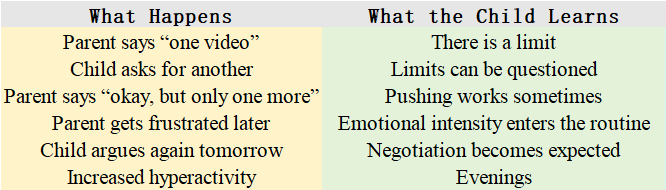
This pattern trains both sides.
The child learns persistence occasionally changes the outcome.
The parent learns that giving one extra video temporarily avoids conflict.
Both reactions make sense in the moment. Neither solves the long-term problem.
One parenting article described repeated extensions like “five more minutes” or “just finish this part” as teaching children that endings are flexible and negotiable.
That does not mean parents should become cold or rigid. It means boundaries work best when they are calm, predictable, and boring.
Why Lectures Usually Fail in the Moment
When emotions are running high, many parents instinctively explain.
They talk about healthy habits, sleep schedules, family rules, and the importance of balance. Although these conversations are valuable, the timing is often poor.
A child who is upset because screen time has ended is usually not in a state to process a lengthy explanation. At that moment, emotions tend to outweigh logic. Long lectures can therefore increase frustration rather than reduce it.
Short, calm statements generally work better. A parent might acknowledge the child’s disappointment while still maintaining the boundary. This approach keeps the interaction focused and prevents the discussion from turning into a debate.

Tips That Parents Can Try
Natural Stopping Points
One mistake many parents make is ending screen time mid-scene or mid-game whenever the clock hits a certain minute.
Research from the University of Washington found transitions were smoother when children stopped at natural break points instead of abrupt interruptions. That means it can help to say:
“After this episode ends.”
“When this level finishes.”
“After this song.”
Natural endings feel psychologically cleaner. Autoplay settings often make this harder because there is no obvious stopping moment anymore. One episode instantly becomes another.
Many families reduce conflict simply by disabling autoplay. That small technical change creates visible endings again.
Repeated Countdowns
Parents are often told to give repeated countdowns.
They provide reminders at ten minutes, five minutes, and two minutes before screen time ends. While this strategy is widely recommended, some research suggests that repeated warnings can sometimes increase distress rather than reduce it. Children may experience each warning as a renewed reminder that something enjoyable is about to end.

Many families have greater success using a combination of one clear warning, a visible timer, and a predictable follow-up activity. This structure creates clarity without repeatedly drawing attention to the impending transition.
Avoid Turning Screens Into Emotional Currency
Many parents accidentally make screens emotionally powerful by using them constantly as rewards, punishments, bargaining tools, or emergency emotional regulation.
Examples include:
“If you behave, you get extra videos.”
“Stop crying and I’ll give you the tablet.”
“Fine, watch another one so I can finish this.”
“You lost screens for the entire week.”
Experts warn that reactive use of screen time can intensify power struggles and shift family interactions into constant negotiations.
This does not mean rewards are always harmful. It means consistency matters more than emotional bargaining. Children cope better when limits feel stable instead of unpredictable.
Change Words
Parents often ask for better phrases because the wording itself can escalate tension.
Here are examples that usually work better:

The calmer the parent sounds, the less emotionally rewarding the argument becomes. That does not create instant cooperation every time. But it reduces escalation.
The Parent Mistake Nobody Talks About
Parents are often so accustomed to resistance that they begin anticipating conflict before it occurs.
When that happens, tension can enter the interaction before the child has even reacted. A parent may approach the transition already expecting an argument, and that expectation can influence tone, body language, and patience.
Approaching the situation with a calmer mindset often changes the outcome. Instead of viewing the interaction as another battle, parents can view it as a routine transition that requires steady guidance.
Final Thoughts
Parents often expect immediate improvement when they introduce a new strategy.
In reality, children frequently test new boundaries before accepting them. If negotiation previously led to extra screen time, it is natural for children to continue trying that approach for a while.

The first week of a new routine may feel more challenging rather than less. However, many parents report that consistent follow-through gradually reduces resistance over time. Community discussions frequently describe improvement occurring over several weeks rather than overnight.
The “one more video” habit is rarely just about videos.
More often, it reflects a challenge with transitions, emotional regulation, and family routines. Children are still developing the skills needed to move smoothly between activities, particularly when those activities are highly engaging.
Parents who successfully reduce screen-time conflicts are not necessarily stricter than other parents. In many cases, they simply provide more structure, greater predictability, and calmer follow-through.
The objective is not perfect compliance. It is a family environment where ending screen time no longer determines the emotional tone of the entire evening.
(This article is intended for informational and educational purposes only and should not replace professional medical, psychological, or developmental advice. Families differ widely in temperament, routines, and needs. Parents concerned about severe emotional reactions, aggression, or developmental challenges related to screen use should consult a qualified pediatrician or child development specialist.)
FQAs
1. Should parents eliminate screens completely if transitions are always difficult?
Not necessarily. Many families find that improving structure around screen time works better than banning screens entirely. Predictable routines, lower-stimulation content, and smoother transitions often reduce conflict significantly.
2. Is it okay to allow extra screen time occasionally?
Yes. Flexibility is normal in family life. Problems usually arise when exceptions become emotionally driven negotiations instead of intentional decisions.
3. What age should children manage screen limits independently?
Self-management develops gradually. Younger children generally need strong external structure, while older children and teens benefit from collaborative rule-setting and increasing responsibility over time.
About Author
Hannah Mercer is a fictional parenting writer and family routine researcher with over a decade of experience studying child behavior, screen habits, and emotional regulation in modern households. Her work focuses on practical parenting systems that reduce daily stress without relying on harsh discipline or unrealistic expectations.
References
Kowert, R. (2025). “Better” screen time is more than just minutes: Quality vs quantity. Nurture Academy.
Numuw. (2026). How to end screen time without a meltdown: 3 words that actually work.
Usfera. (2026). How to create better screen transitions without daily drama.
Stay on this blog for more realistic parenting strategies that make everyday family life calmer, simpler, and more manageable.