
June 2, 2026
Many parents feel emotionally exhausted by 8 PM even when they have not done physically demanding work all day. Emotional regulation, invisible planning, and constant mental tracking quietly consume energy throughout the day. Small interruptions and repeated decision-making create cumulative stress that parents often underestimate. The emotional “mental load” of parenting is now widely recognized in burnout research and family psychology discussions. Practical recovery habits, shared responsibilities, and lower perfection expectations can significantly reduce evening exhaustion.

Estimated Reading Time: 11 minutes┃Post By Cameron Blythe
The kitchen is finally quiet. Lunchboxes are sitting near the sink. Someone forgot to put their shoes away again. The dishwasher hums softly while a parent stands in front of the refrigerator staring blankly inside, unable to remember what they came to get. It is only 8 PM, yet mentally it feels closer to midnight.
For many parents, this kind of exhaustion is confusing because the day may not have looked physically difficult from the outside. There may have been no intense workout, no manual labor, and no major emergency. Yet emotionally, the brain feels completely depleted. Parenting researchers increasingly describe this as emotional exhaustion linked to chronic mental load and continuous emotional regulation. Studies on parental burnout consistently identify emotional exhaustion as one of the strongest early warning signs of parental burnout.
Parents are not simply completing tasks throughout the day. They are constantly monitoring emotions, managing conflicts, anticipating problems, remembering schedules, calming reactions, and maintaining stability inside the household. Most of this work is invisible, which is one reason so many parents feel guilty for being exhausted even after “ordinary” days.
The 8 PM Crash Is Usually Emotional, Not Physical
Physical tiredness and emotional tiredness create very different experiences. Physical exhaustion often improves after resting for a short period. Emotional exhaustion feels heavier and harder to explain. Many parents describe it as brain fog, irritability, emotional numbness, overstimulation, or the feeling that even small requests suddenly become unbearable.
At 8 PM, a child asking for help finding pajamas or requesting another snack may not sound demanding on paper. Yet after an entire day of emotional output, those simple moments can feel overwhelming. Parenting burnout research shows that prolonged emotional strain changes how parents experience everyday interactions, especially during periods of chronic stress.
Here is how emotional labor often compares with physical labor during parenting:
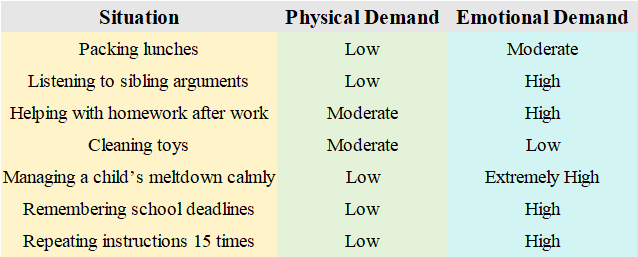
Many parents assume household chores are the most exhausting part of family life. In reality, emotional regulation and cognitive overload are often far more draining than physical activity itself.
Causes of Parents' Emotional Exhaustion
The “Always On” Brain Problem
One parent on Reddit described parenting mental load as having “tabs open that never close.” That description resonated with thousands of parents because caregiving rarely allows the brain to fully relax.
Throughout the day, parents mentally track dozens of details simultaneously. They remember school forms, monitor symptoms of illness, anticipate emotional reactions, manage schedules, plan meals, and think ahead to tomorrow’s responsibilities while still handling today’s problems. None of these thoughts seem overwhelming individually, but together they create constant background pressure.
Recent research on household mental load describes this burden as the invisible cognitive and emotional labor associated with organizing family life. Researchers found that emotional fatigue often comes less from the amount of time spent doing tasks and more from the responsibility of mentally managing them.
A parent can finish vacuuming in twenty minutes, but worrying about a child struggling socially at school can stay mentally active for the entire day. That difference explains why emotional exhaustion often feels harder to recover from than physical tiredness.
Emotional Regulation Is Invisible Labor
One of the most underestimated parts of parenting is the constant need for emotional self-control. Parents spend large portions of the day regulating their own reactions in order to create emotional safety for their children.

This happens in ordinary moments constantly. A parent calmly responds after milk spills onto important paperwork. Another speaks gently despite being overstimulated and sleep-deprived. Someone hides financial stress during dinner so children do not feel anxious. Others patiently answer the same question ten times without showing frustration.
Although these moments may appear small, emotional regulation requires significant psychological energy. Research on parental burnout repeatedly identifies emotional exhaustion as the first stage of long-term parental burnout progression.
As emotional energy decreases throughout the day, parents often notice they become less patient, less emotionally responsive, and more mentally distant by evening. That emotional flattening does not mean they love their children less. It simply means emotional resources have limits.
Decision Fatigue Hits Parents Hard
Parents make hundreds of small decisions every single day. They decide whether behavior is caused by tiredness or defiance, whether a fever requires medical attention, whether consequences should happen immediately, and whether a child needs comfort, discipline, rest, or reassurance.
Over time, these nonstop micro-decisions create decision fatigue, a psychological state where the brain becomes less capable of managing stress effectively. By evening, many parents are no longer reacting only to the current situation. They are reacting with an already depleted nervous system.

This helps explain why small evening problems can suddenly feel emotionally enormous. A spilled cup of juice at 9 AM may feel manageable. The exact same spill at 8 PM may feel catastrophic simply because emotional resources are already exhausted.
Parents Often Experience Interrupted Recovery
Most adults recover emotionally through uninterrupted downtime. Parenting often interrupts that recovery process repeatedly.
A parent may finally sit down at night only to hear a child call from another room saying they cannot sleep, forgot something important, or suddenly need comfort. The nervous system never fully powers down. Over time, this ongoing interruption reduces emotional recovery and increases chronic exhaustion.
Research examining daily parenting exhaustion found that parental stress levels fluctuate heavily based on perceived support inside the household. Parents with lower support systems experienced significantly higher exhaustion levels.
Even short periods of reliable support can reduce emotional strain because they allow the brain to briefly stop monitoring everything simultaneously.
The Emotional Weight of Being the “Default Parent”
In many households, one parent unintentionally becomes the primary emotional manager of the family. That person tracks appointments, monitors emotional changes, remembers school communication, plans meals, organizes schedules, and anticipates potential problems before anyone else notices them.
Recent studies on mental load found significant inequalities in how emotional and organizational responsibilities are distributed inside families, particularly among working mothers.
Online parenting communities frequently describe this experience as carrying invisible labor that other family members do not fully notice. One parent explained that writing down every mental task they tracked during a single day finally helped relatives understand the constant background pressure they were experiencing.
The exhaustion comes not from one major responsibility but from carrying hundreds of tiny ongoing responsibilities simultaneously.
Why 8 PM Feels So Vulnerable
By evening, several forms of stress begin stacking together at the same time. Emotional regulation fatigue, sensory overload, unfinished responsibilities, physical tiredness, and decision fatigue combine into one emotionally fragile period of the day.
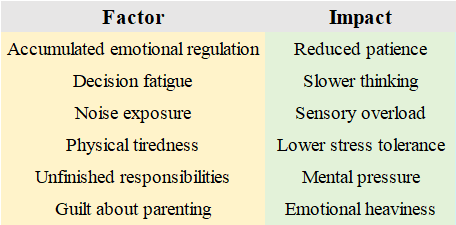
This combination creates what many parents informally describe as the “8 PM wall,” where emotional resilience suddenly collapses even though the day technically is not over yet.
What Actually Helps Reduce Emotional Drain
Many parents try solving emotional exhaustion through better productivity systems alone. They create stricter schedules, optimize routines, or attempt to become more efficient. While organization can help, emotional exhaustion usually requires emotional recovery rather than simply better performance.
Reducing emotional multitasking is often more effective than increasing efficiency. Instead of handling five parenting concerns simultaneously, focusing on one responsibility at a time reduces cognitive overload.
Short periods of decompression also matter more than many parents realize. Even twenty uninterrupted minutes of silence, reading, walking, music, or sitting quietly can interrupt the cycle of overstimulation and emotional depletion. Experts discussing parental burnout frequently emphasize the importance of recovery breaks and lowering unrealistic expectations.
Externalizing mental load can also reduce pressure. Shared calendars, written schedules, visible task lists, and clearly divided responsibilities reduce the need to mentally track everything internally.
Perhaps most importantly, parents benefit from recognizing emotional labor as real labor. Calming a frightened child for thirty minutes may leave no visible result afterward, but it still requires substantial emotional energy.

Children Often Feel Safer With Regulated Parents Than Perfect Parents
Many exhausted parents believe they must hide all signs of emotional fatigue from their children. In reality, emotionally regulated honesty is often healthier than forced perfection.
Recent discussions around parental burnout have highlighted how chronic stress can push parents toward emotional suppression, where they hide emotions completely in an attempt to appear endlessly cheerful and stable.
Healthy emotional modeling can sound simple and calm:
● “I’m feeling very tired tonight.”
● “I need a quiet moment.”
● “Today felt busy for me too.”
Statements like these help children understand that emotions are manageable rather than dangerous. Children generally feel safer around authentic emotional regulation than unrealistic perfection.
Emotional Exhaustion Does Not Mean Failure
Many loving parents quietly assume that feeling emotionally exhausted means they are failing at parenting. In reality, emotional exhaustion is often evidence of sustained emotional involvement and responsibility.
Modern parenting requires constant attention, emotional regulation, cognitive organization, and psychological flexibility. Research over the past fifteen years increasingly recognizes parental burnout and emotional overload as significant public health concerns rather than individual weaknesses.
A parent standing silently in the kitchen at 8 PM is usually not exhausted because they are weak or incapable. More often, they are emotionally drained from carrying invisible responsibilities all day long. Understanding that difference matters because parents recover more effectively when they stop interpreting emotional exhaustion as personal failure.
(This article is intended for informational and educational purposes only and should not replace professional mental health or medical advice. Parents experiencing persistent emotional exhaustion, depression, anxiety, or severe burnout symptoms should consider consulting a licensed healthcare professional or therapist.)
FAQs
1. Is emotional exhaustion the same as parental burnout?
No. Emotional exhaustion is often an early warning sign of parental burnout, but burnout usually includes additional symptoms such as emotional distancing, chronic hopelessness, and reduced fulfillment in parenting responsibilities.
2. Why do small evening problems feel so overwhelming as a parent?
By evening, many parents are already dealing with accumulated emotional regulation fatigue, sensory overload, unfinished mental tasks, and decision fatigue, which significantly lowers emotional resilience.
3. Can stay-at-home parents experience this even without outside employment?
Absolutely. Emotional labor, invisible planning, repeated interruptions, and ongoing caregiving responsibilities can create severe emotional exhaustion regardless of employment status.
About Author
Cameron Blythe is a fictional family wellness writer specializing in parental emotional health, cognitive overload in modern parenting, and family stress dynamics. Her work focuses on translating psychological research into realistic, everyday parenting experiences that readers can immediately recognize and relate to. She frequently writes about invisible labor, emotional regulation, and the psychological pressures facing modern families.
References
Ren, X., Cai, Y., Wang, J., & Chen, O. (2024). A systematic review of parental burnout and related factors among parents. BMC Public Health.
Barigozzi, F., Biroli, P., Monfardini, C., Montinari, N., Pisanelli, E., & Vitellozzi, S. (2025). Beyond Time: Unveiling the Invisible Burden of Mental Load.
Mikolajczak, M., Aunola, K., Sorkkila, M., & Roskam, I. (2023). 15 Years of Parental Burnout Research: Systematic Review and Agenda. Current Directions in Psychological Science.
Christmas burnout: why stressed parents find it harder to be emotionally honest with children. (2025). The Guardian.
Stay awhile and explore more parenting articles on this blog for realistic family insights, emotional wellness guidance, and practical strategies for everyday parenting challenges.