
May 30, 2026
In this Article:
● A simple “backpack drop zone” can significantly reduce school-morning chaos.
● Children become more independent when every school item has a consistent home.
● Small environmental changes often work better than repeated verbal reminders.
● Even tiny apartments can create effective launch zones with low-cost solutions.

Estimated Reading Time: 11 minutes┃Post By Hollis Ember
“Where’s your folder?”
“I thought you packed your lunch.”
“My sneakers were right here yesterday!”
For many families, school mornings feel less like a routine and more like a daily scramble where time disappears in small, invisible ways. A missing shoe, a misplaced permission slip, or a backpack that somehow migrated to another room can quickly turn a calm morning into a rushed exit.
This pattern is rarely caused by a lack of effort. Instead, it comes from how many small tasks stack up at the exact moment when everyone’s attention is at its lowest. By the time breakfast is halfway done, the household is already reacting rather than executing a plan.
One practical way to interrupt this cycle is the “backpack drop zone,” often called a “launch pad” in home organization systems. The concept is straightforward: create one clearly defined place near the home exit where all school-related items are stored and retrieved every day.
Research and organizing professionals consistently describe these entryway “launch zones” as a way to reduce morning searching, improve consistency, and support children’s independence by giving every item a predictable home.
Why Mornings Become So Stressful
Most chaotic mornings are not the result of one big failure—they are the accumulation of small inefficiencies.
Children are expected to track multiple responsibilities at once: homework, water bottles, lunchboxes, jackets, sports gear, and permission slips. Adults are simultaneously managing time pressure, transportation, and work schedules. The system breaks down when these responsibilities are spread across different rooms and surfaces.
A typical breakdown looks like this:
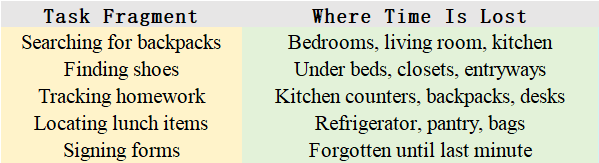
Each individual delay is small—often just 2 to 5 minutes—but together they create a 15–30 minute disruption window.
The real issue is not time alone; it is cognitive load. Every “Where is it?” question forces a new decision under pressure. That is exactly the type of friction a drop zone is designed to remove.
What a Backpack Drop Zone Actually Looks Like
A backpack drop zone does not require extra space or renovation. It is simply a designated “home base” for school items.
In many households, it takes one of these forms:
● A set of hooks beside the front door
● A bench with storage baskets underneath
● A hallway shelf with labeled bins
● A narrow entryway wall with individual stations
● A corner in the kitchen or garage used consistently
The key is not design complexity but behavioral consistency.
A functional drop zone typically includes:
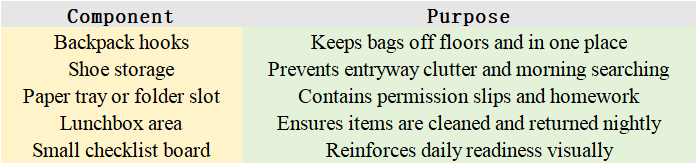
Organizing systems often work best when each item has a single, obvious “home,” reducing the need for repeated verbal reminders.
Even simple setups—like labeled hooks at child height—can significantly improve follow-through.
The Real Reason This Trick Works
At its core, the backpack drop zone works because it transfers responsibility from memory to environment.
Children are not inherently inconsistent. They are managing too many items at once, often during a low-focus time of day. Expecting them to remember everything without environmental support creates predictable breakdowns.
When a drop zone is introduced, the rule becomes external and visible:
“School items always go here.”
This reduces decision-making from multiple steps (“Where did I leave it?” “Did I pack it?”) to a single action (“Put it in the zone”).
In behavioral terms, this is a shift from recall-based organization to location-based organization.
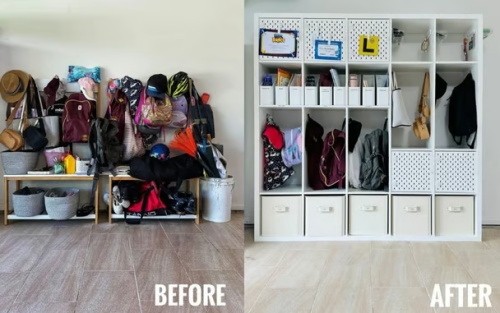
It also changes how habits form. Instead of relying on reminders, the environment becomes the cue.
Building a Drop Zone That Actually Lasts
What makes a drop zone durable is not complexity or design. It is whether the system survives ordinary mornings when everyone is rushed, distracted, and tired. The most effective setups are the ones that stay usable even when no one is actively thinking about them.
The goal is to build something that continues to function with minimal effort, not something that requires constant correction or “resetting the system” as a special task.
Start Small and Keep It Practical
The most common reason drop zones fail is overdesign. Families often begin with too many components at once: separate bins for every category, multiple labeled containers, or highly specific sorting rules. It feels organized at first, but quickly becomes too much to maintain in a real household rhythm.
A more stable approach is to reduce everything to a small set of fixed actions. Backpacks go in one place, shoes go in one place, and school papers go in one place. That is enough for most homes to see immediate improvement.
The fewer decisions required at the end of the day, the more likely the system will actually be used.
Make the Setup Obvious Without Thinking
A long-lasting drop zone does not depend on reminders or instructions. It works because the environment makes the correct behavior the easiest option.

When a child walks through the door and immediately sees a hook at their height, the action becomes automatic. When shoes have a single obvious landing spot, they are less likely to end up scattered elsewhere. The system should be visually self-explanatory, even to someone who is tired or distracted.
If someone has to stop and ask, “Where does this go?” the system is already too complicated for long-term use.
Reset It Every Night in a Simple Way
Even the best drop zone will slowly break down without a daily reset. The key is not intensity, but repetition. A short, predictable evening routine keeps the system from collapsing into clutter.
At night, backpacks should be returned to their hooks, lunchboxes cleared out, papers placed into one consistent location, and shoes returned to their designated spot. Devices, if used for school, can also be charged in a fixed place so they are ready the next day.
This does not need to be a detailed checklist or a long process. What matters is that it happens regularly enough that the system never fully falls apart.
Let the System Adapt to How Your Family Actually Behaves
No drop zone is perfect from day one. The system should evolve based on how the household naturally interacts with it.
If backpacks keep ending up on the floor instead of hooks, the hooks may need to be lower or more visible. If papers still get scattered, the paper storage may need to be reduced to a single folder instead of multiple sections. If shoes drift into bedrooms, the entryway storage may need to be more convenient than the bedroom alternative.
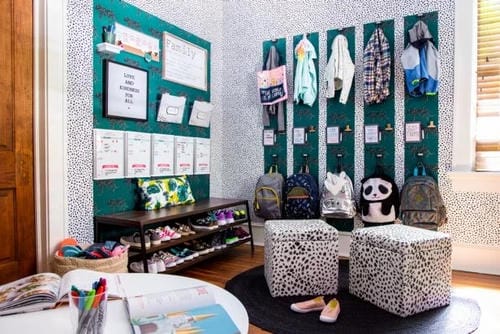
These adjustments are not failures. They are part of making the system match real behavior instead of ideal behavior.
A drop zone only becomes stable when it is shaped by reality, not theory.
Give Children a Sense of Ownership
A system lasts longer when children feel like it belongs to them, not just something imposed by adults. Even small involvement changes how consistently they use it.
When children help choose where their backpack hook goes, pick their label, or decide which basket is theirs, they are more likely to follow the system without constant reminders. The routine becomes something they participate in rather than something they are directed to do.
Over time, this shifts responsibility away from parents needing to constantly enforce the system.
The Biggest Mistake Parents Make
The most common failure point is overdesigning the system.
Many parents attempt to create elaborate “command centers” with too many bins, labels, or steps. While visually appealing, these systems often fail because they require too much maintenance.
Effective drop zones share three characteristics:
1. Minimal steps — One or two actions per item
2. High visibility — Items are easy to see and access
3. Low friction — Putting things away is easier than leaving them out
If a system requires constant correction, it will not survive real mornings. Simplicity is not a downgrade—it is what makes the system durable.
Small-Space Families Can Still Use This Trick
Limited space does not prevent implementation. In fact, small homes often benefit more because clutter becomes visible faster.
Examples of compact solutions:
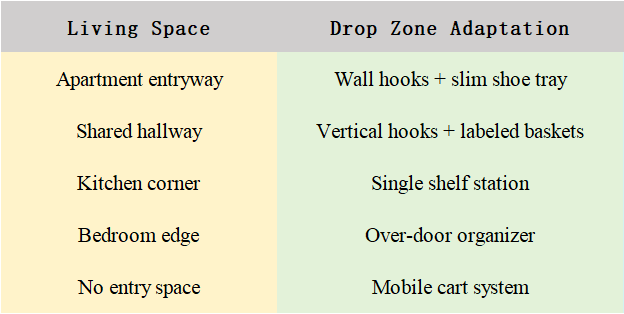
The goal is not to create new space, but to assign meaning to an existing one.
Even a 2–3 foot wall section can function effectively if used consistently.
How the Drop Zone Builds Independence
Over time, the drop zone shifts responsibility from parent-led reminders to child-led routines.
Instead of:
“Did you pack your backpack?”
“Where are your shoes?”
“Don’t forget your water bottle!”
The system becomes:
Everything is already in one visible location.
This reduces repeated verbal prompting and allows children to participate in their own readiness process.
It also improves emotional tone. When mornings are less reactive, children are more likely to arrive at school in a regulated state rather than a rushed or anxious one.
Final Thoughts
A backpack drop zone may look like a small organizational tweak, but its impact is structural. It removes repeated decision-making, reduces morning chaos, and creates a predictable system that children can follow independently.
Most morning stress does not come from lack of effort—it comes from scattered systems competing for attention at the worst possible time.
When school items have one clear home, mornings stop feeling like a search operation and start functioning like a routine.
And that shift, even if small at first, tends to change the entire tone of the household.
(This article is intended for informational and educational purposes only. Families should adapt organization systems based on their household size, space, and children’s developmental needs.)
FAQs
1. At what age can children use a drop zone independently?
Most children can participate in simple routines around ages 4–6, with independence increasing through elementary school as habits form.
2. What if my child still forgets items even with a drop zone?
This is normal during early adoption. Consistency over 2–4 weeks is typically needed before the system becomes automatic.
3. Can a drop zone work in very small apartments?
Yes. Even a single wall section, hook system, or portable cart can function effectively if used consistently.
About the Author
Hollis Ember is a fictional parenting writer focused on practical home systems, family routines, and child organization strategies. Her work emphasizes realistic, low-maintenance solutions designed for everyday households rather than idealized environments.
References
K12 Tutoring. (2025). Organizing backpacks for smoother daily routines.
Understood.org. (2026). 8 tips for organizing your child’s backpack.
Parents. (2025). 8 tips for getting out the door on time for school.
The Spruce. (2025). Back-to-school organization tricks parents swear by.
Stay on this blog for more realistic parenting systems that make everyday family life calmer and more manageable.