
June 1, 2026
In the Article:
● Mental load and emotional monitoring can drain parents faster than physical chores.
● Many parents spend entire days planning, remembering, anticipating, and managing family emotions.
● Invisible parenting work often creates resentment because it is difficult to measure or explain.
● Small systems, clearer responsibility-sharing, and realistic expectations can reduce daily burnout.

Estimated Reading Time: 11 minutes┃Post By Remy Alder
The kitchen can finally be spotless. The laundry baskets may be empty for the first time in days. The toys might even be organized back into bins after hours of cleaning. Yet many parents still sit down at the end of the night feeling mentally depleted in a way that physical chores alone cannot explain.
That exhaustion often comes from the invisible work of parenting rather than the visible work.
Parents are not simply cooking meals, washing clothes, and driving children to activities. Throughout the day, they are constantly tracking schedules, monitoring emotions, anticipating problems, remembering details, and mentally preparing for future needs. A parent may look physically still while their mind runs through ten different responsibilities at once.
Researchers increasingly describe this ongoing background effort as “mental load” or “cognitive labor,” referring to the invisible planning, organizing, and emotional management required to keep family life functioning smoothly. Studies show that this form of labor is mentally taxing because it rarely stops completely, even during rest periods.
Many parents explain that the hardest part is not the physical tasks themselves, but the nonstop responsibility of remembering everything connected to those tasks. A parent might spend only thirty minutes preparing dinner, yet spend the entire day mentally planning ingredients, managing schedules, predicting complaints, and making sure everyone will actually eat the meal.
This ongoing mental activity creates a kind of exhaustion that is difficult to measure because there is rarely a visible endpoint.
The Parenting Tasks Nobody Notices
Visible chores are easy for other people to recognize because they produce immediate, concrete results. Invisible parenting tasks are different because they mostly happen inside a parent’s mind.
A clean kitchen is visible. Remembering that a child needs a permission slip tomorrow morning is invisible.
Laundry is visible. Tracking which child suddenly outgrew winter clothes is invisible.
Bath time is visible. Managing a child’s overtired emotional meltdown during bath time is invisible.
The table below shows how ordinary household chores often involve a second layer of hidden parenting work happening simultaneously.
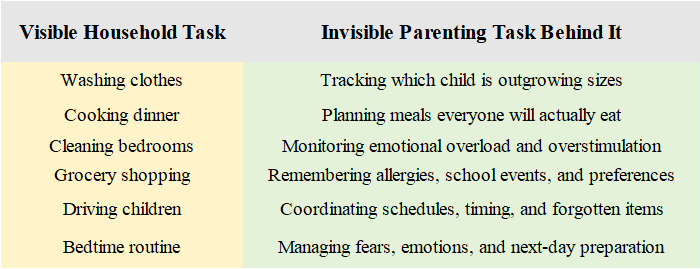
Many parents describe feeling like they are functioning as the “background operating system” for the household. One parent on Reddit described parenting as being “the planner, the reminder app, the researcher, and the person keeping everything moving.”
Another parent explained that the hardest part was not physically feeding the family but “thinking about feeding everyone all day long.”
These comments reflect a common reality in modern parenting: invisible labor often consumes more emotional energy than physical labor because the brain never fully powers down.
Why Mental Load Feels Heavier Than Physical Chores
Physical chores generally have a beginning and an end. Once the dishes are washed or the floor is vacuumed, the task is temporarily complete.
Mental load does not operate that way.
Parents often remain mentally engaged long after the visible work is finished. Even while working, resting, or trying to sleep, many parents continue thinking about schedules, emotional issues, appointments, school obligations, meals, and future responsibilities. Research on domestic cognitive labor shows that family-related mental work frequently spills into other parts of life, including paid work and personal downtime.
A normal weekday may appear manageable from the outside while being mentally exhausting internally.
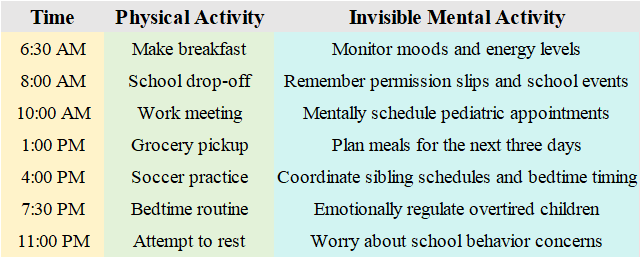
The parent may appear physically calm during large portions of the day, but mentally they are managing dozens of ongoing calculations.
Researchers have noted that this invisible thinking work is often disproportionately carried by one parent, particularly within households where one person becomes the “default manager” for family logistics.
That role becomes exhausting because responsibility is not limited to completing tasks. The parent must also remember the tasks, anticipate future problems, and ensure nothing important is forgotten.
Emotional Management Is One of the Hardest Invisible Jobs
One of the most draining parts of parenting is emotional regulation work.
Parents are often expected to absorb the emotions of everyone in the household while remaining calm themselves. A child may wake up angry, another may cry over homework, a sibling argument may suddenly erupt, or a teenager may shut down emotionally after school. In many families, the parent becomes the emotional stabilizer for everyone else.
This kind of emotional management requires constant self-control and awareness. Parents frequently monitor their own tone of voice, reactions, body language, and patience levels while simultaneously helping children regulate emotions they cannot yet handle independently.

Even when parents are sitting still beside a child, they may be doing intense emotional work internally:
● staying calm during tantrums,
● preventing escalation,
● validating feelings,
● setting boundaries,
● and trying to maintain emotional safety for everyone involved.
Researchers studying invisible household labor identify emotional monitoring as one of the most demanding forms of mental labor because it requires continuous vigilance and emotional self-management.
This helps explain why many parents feel emotionally exhausted after days that did not seem physically difficult.
The “Always Remembering” Problem
A major source of parenting fatigue comes from the constant responsibility of remembering details for the entire household.
Parents often mentally carry hundreds of small pieces of information simultaneously:
● doctor appointments,
● school deadlines,
● food preferences,
● birthday gifts,
● sports schedules,
● clothing sizes,

● emotional concerns,
● medication refills,
● permission slips,
● family calendars,
● and social commitments.
None of these responsibilities seem overwhelming individually. The exhaustion develops because all of them must be mentally tracked at the same time.
Researchers refer to this as “domestic cognitive labor,” meaning the invisible work of organizing, anticipating, and coordinating family life.
Parents frequently describe feeling like their brains are overloaded with unfinished tabs that never fully close. One Reddit user explained that the mental load involved “constant tracking of meals, appointments, shopping lists, emotional needs, school stuff, cleaning, birthdays, and somehow also remembering to breathe.”
The frustrating part is that successful invisible labor often goes unnoticed precisely because it prevents problems before they happen.
Nobody notices when the correct soccer uniform was remembered ahead of time. Nobody notices when a meltdown was avoided because bedtime was adjusted earlier. Nobody notices the emotional conflict prevented through careful planning.
Invisible parenting work is often only recognized when something goes wrong.

Small Changes That Reduce Invisible Parenting Stress
Parenting will always involve mental effort, but certain practical adjustments can reduce long-term cognitive overload.
One important change is shifting from “helping” to true responsibility ownership. Mental relief happens when one parent no longer has to monitor or delegate a specific responsibility at all.
For example, instead of asking, “What can I help with?” it is more effective for one parent to fully own a category such as school communication, medical scheduling, or grocery management.
External systems can also reduce mental pressure. Shared calendars, reminder apps, whiteboards, grocery systems, and weekly planning sessions reduce the need for parents to rely entirely on memory. Some newer parenting apps are even being designed specifically to reduce household mental load and improve communication between partners.
Another important adjustment is lowering unrealistic expectations. Many parents silently pressure themselves to optimize every area of family life simultaneously:
● perfectly healthy meals,
● organized homes,
● ideal emotional responses,
● educational enrichment,
● and constant productivity.
Perfectionism often intensifies mental overload because parents feel responsible for preventing every possible problem.
Parents also benefit from protected mental downtime. Even after children go to sleep, many parents continue researching, organizing, planning, and preparing for future tasks. Intentionally creating periods without household planning can help reduce cognitive exhaustion.
Finally, verbal acknowledgment matters more than many families realize. Simple recognition such as “I know you carry a lot mentally” or “Thank you for managing all of this” helps reduce the isolation that often accompanies invisible labor.
(This article is intended for informational and educational purposes only and should not replace professional mental health, medical, or family counseling advice. Every family dynamic is different, and parents experiencing severe stress, anxiety, or burnout should consider speaking with a qualified healthcare or mental health professional.)
FAQs
1. What is the difference between physical chores and mental load in parenting?
Physical chores involve visible actions like cleaning or cooking. Mental load refers to the invisible planning, remembering, organizing, and emotional monitoring required to manage family life.
2. Why does invisible parenting work feel so exhausting?
Invisible work rarely has a clear endpoint. Parents often stay mentally engaged all day through anticipation, decision-making, and emotional regulation, even during rest periods.
3. Can mental load affect both mothers and fathers?
Yes. Although studies often show mothers carrying a larger share of cognitive labor, fathers also experience invisible pressures related to parenting, finances, emotional responsibility, and work-family balance.
About Author
Remy Alder is a fictional family wellness writer and former early childhood education consultant who specializes in parental burnout, emotional development, and modern family dynamics. For over a decade, she has written practical parenting content focused on the psychological realities of raising children in busy households.
References
Barigozzi, F., Biroli, P., Monfardini, C., Montinari, N., Pisanelli, E., & Vitellozzi, S. (2025). Beyond time: Unveiling the invisible burden of mental load. Institute of Labor Economics.
Vettoretto, E., Minello, A., Ortensi, L. E., & Tosi, F. (2026). Understanding the dimensions of mental labor: The invisible load of Italian mothers. Frontiers in Sociology.
Weeks, A. C., & Ruppanner, L. (2024). A typology of US parents’ mental loads: Core and episodic cognitive labor. Journal of Marriage and Family.
Stay awhile and explore more parenting articles on this blog for practical insights into the everyday challenges families quietly face behind closed doors.