May 25, 2026
Key Highlights:
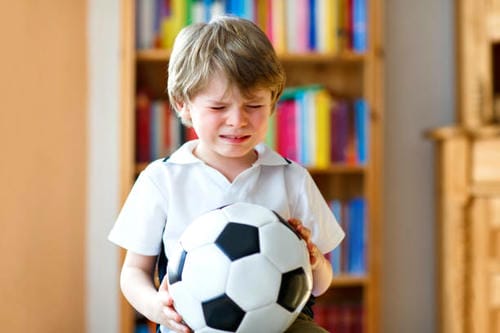
● Children who take losing personally are usually responding to strong feelings of shame and frustration rather than the game itself.
● Because their emotional regulation is still developing, losses can feel like threats to their identity instead of isolated outcomes.
● Parents can help reduce emotional outbursts by setting expectations before games and guiding children through recovery during upset moments.
● When adults model calm behavior after losing, children are more likely to develop better sportsmanship over time.
● Regular, low-pressure exposure to losing helps children separate their self-worth from the results of games.
Estimated Reading Time: 12 minutes┃Post By Quinn Ashby
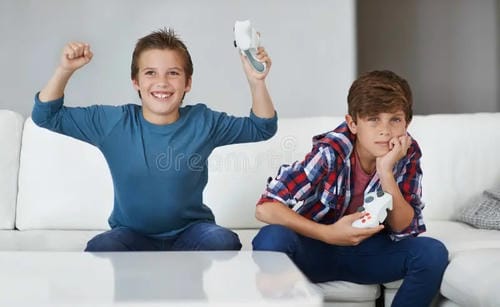
A child throws a board game piece across the table after losing. Another refuses to shake hands after a soccer match, insisting the referee was “unfair.” A third cries in the car ride home for 20 minutes after finishing second in a simple classroom game.
These reactions are not rare—and they are not about the game. They are about what the game represents in the child’s internal emotional system: status, competence, control, and self-worth.
Understanding this distinction is critical. Because if parents treat the behavior as “bad sportsmanship only,” they miss the underlying mechanism driving it—and the opportunity to reshape it.
What “taking losing personally” actually looks like
Below is a breakdown of common patterns observed in family game settings:
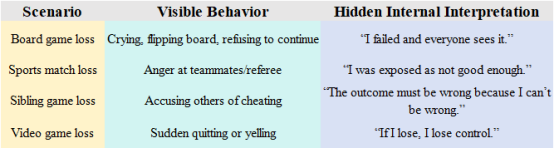
Across all of these, the surface behavior is different—but the emotional core is consistent: loss is being interpreted as identity-level failure, not just an event.
This is consistent with developmental research showing that children often equate performance outcomes with self-worth until later cognitive maturation allows separation of “I did badly” from “I am bad.”
Why losing feels disproportionately intense for some children
1. Emotional regulation systems are still under construction
Children are still developing the brain systems responsible for regulating emotional intensity, particularly the prefrontal cortex and its connections to the limbic system. The limbic system can generate strong emotional reactions very quickly, especially around perceived failure or threat, while the regulatory systems that help slow, reinterpret, or soften those reactions are still immature. As a result, when a child loses a game, the emotional response can escalate rapidly and feel overwhelming before cognitive reasoning has a chance to intervene. The experience is not simply disappointment; it becomes a surge of emotion that the child does not yet have strong internal tools to manage.
You may notice:
Fast escalation (seconds, not minutes)
Difficulty hearing explanations mid-upset
Physical responses (tears, tension, throwing objects)
At this stage, logic (“it’s just a game”) is neurologically inaccessible.
2. Identity fusion: “losing = I am less valuable”
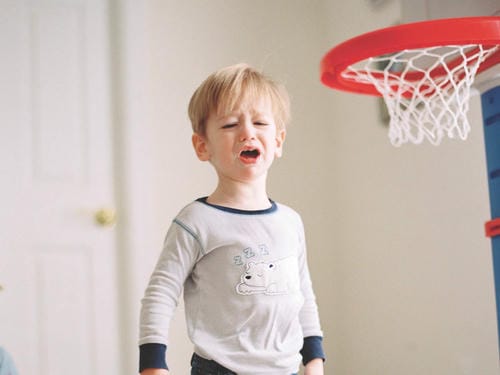
Many children, especially in early to middle childhood, have not fully developed a clear psychological separation between what they do and who they are. Because of this, a loss in a game can easily be interpreted as a reflection on personal value rather than just performance in a specific activity. Instead of thinking “I lost the game,” the internal experience can become “I am a loser,” which transforms a situational outcome into an identity-based judgment. This makes losing feel much more threatening, because it is no longer about an event but about the self.Some children develop a tight coupling between performance and self-worth:
Winning → “I’m smart / good / liked”
Losing → “I’m stupid / bad / rejected”
This is especially common in:
Highly competitive environments
Children sensitive to correction
Kids exposed to frequent comparison (siblings, school rankings, sports)
When this fusion is strong, losing triggers a threat response similar to social rejection.
3. Perfectionistic or conditional self-worth learning
Some children develop beliefs that their worth depends on performance outcomes, often through repeated exposure to evaluative environments or implicit messages from adults and peers.

When praise is primarily tied to winning or being the best, or when mistakes are met with visible disappointment, children may learn to equate success with value and failure with diminished worth. In this framework, losing a game is not neutral feedback but evidence that they are not good enough. This interpretation naturally intensifies emotional reactions because the stakes feel personal and existential rather than situational.
Some children internalize implicit or explicit messages such as:
● “Winning means you did well; losing means you failed”
● “Being good means being the best”
● “Mistakes reduce your value”
These beliefs often come from:
● Highly evaluative coaching or parenting styles
● Overpraise tied only to success (“You’re amazing when you win”)
● Visible adult disappointment after failure
● Competitive environments with constant ranking
Once internalized, losing is not neutral feedback—it becomes evidence of reduced worth.
4. Learned behavior from the environment (often unintentional)
Children are highly attuned to the emotional reactions of adults and the surrounding environment. If caregivers, coaches, or peers treat losing as highly significant or react with tension, disappointment, or criticism, children often internalize that emotional framing. Even subtle cues such as tone of voice, facial expressions, or silence after a game can communicate that losing is serious or undesirable. Over time, this can condition the child to experience losses as emotionally loaded events rather than neutral parts of play. Children do not only learn how to play—they learn how adults treat winning and losing.
Common reinforcing signals:
Adults celebrating victories intensely
● Adults showing visible irritation when losing
● Praise focused only on winning outcomes
● Comparisons between siblings or peers
Even subtle cues can teach that winning = emotional safety.
The most important parenting shift: from “correcting behavior” to “coaching recovery”
A common mistake is to intervene only after the meltdown:
“Don’t be a sore loser.”
“It’s just a game.”
“Stop overreacting.”
These statements target behavior, but ignore the emotional system generating it.
A more effective approach is structured in two phases:
Phase 1: Before the game (set the emotional contract)
This step is frequently skipped, yet it determines 50% of outcomes.
● “We are playing to have fun and practice.”
● “Sometimes you will win, sometimes you will lose.”
● “If losing feels hard, we will take a pause and reset.”
You are not trying to prevent emotion—you are pre-labeling it as acceptable.
Phase 2: During the loss (do NOT process the lesson yet)
When the loss happens, the child is not in a learning state—they are in a regulation state.
What to do instead:
● Keep voice low and slow
● Validate emotion without debate
● Avoid explanation
Effective responses:
● “That felt really disappointing.”
● “You really wanted that to go differently.”
● “I see how upset you are.”
What to avoid in the moment:
● “You need to be a good sport.”
● “There’s no reason to cry.”
● “You’re overreacting.”
These increase emotional resistance because they conflict with the child’s lived experience.
Phase 3: After regulation (Structured recovery coaching)
Only once the child’s body has calmed (breathing normal, voice stable) should you introduce reflection. A useful sequence:
Name the event: “You lost that game.”
Name the feeling: “That felt frustrating.”
Separate identity from outcome: “Losing doesn’t change who you are.”
Offer a next-step tool: “Next time, let’s try a reset breath when it feels big.”
A real-world case example (home scenario)
Family setting: 7-year-old, board game night
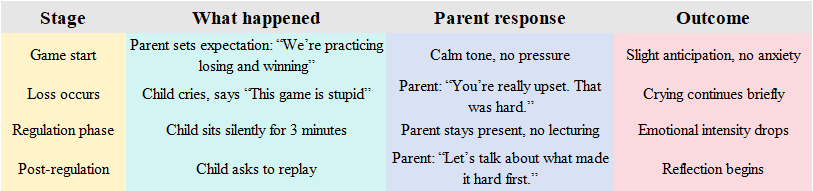
Over time, repetition of this structure reduces escalation frequency more effectively than punishment or forced “good sportsmanship” demands.
Long-term goal: Redefining what “winning” means
The long-term objective is not to eliminate disappointment or prevent children from feeling upset when they lose, but to gradually reshape how they interpret winning and losing in the first place. Over time, children need to learn that outcomes in games are feedback events rather than evaluations of personal worth. This shift allows “losing” to be experienced as a temporary result within a learning process, rather than as evidence of inadequacy.
As this perspective develops, the internal narrative changes from “I lost, therefore I am not good at this” to something more flexible and constructive, such as “I lost, so I can see what I need to improve” or “this was difficult, but I can try again.” This reframing reduces emotional volatility because it removes the identity threat from the outcome itself.
Ultimately, redefining what winning means requires consistent adult modeling, repeated low-stakes exposure to both success and failure, and steady reinforcement that effort, persistence, and recovery matter more than any single result.
(This article is for educational purposes only and does not replace professional psychological or clinical advice. If a child’s emotional reactions are severe, persistent, or impairing daily functioning, consultation with a qualified child psychologist or pediatric specialist is recommended.)
FAQs
1. Should I let my child win to prevent meltdowns?
Occasionally, yes for confidence-building—but frequent “letting them win” can delay emotional resilience. Balanced exposure to both winning and losing is more effective long-term.
2. How do I stop my child from accusing others of cheating?
Focus on emotional labeling (“It feels unfair when you lose”) before addressing logic. Only after calmness returns should rules be reviewed.
3. At what age do kids typically handle losing better?
Most children show noticeable improvement between ages 7–10 as cognitive separation between self-worth and outcomes strengthens.
About Author
Dr. Quinn Ashby is a developmental psychology writer specializing in childhood emotional regulation, family systems, and behavior development in early education settings. She has worked with educators and parents to translate child psychology research into practical home strategies for over 12 years.
References
Cleveland Clinic. (2021). Sore loser? How to help your child handle disappointment.
Parents. (2024). 11 signs your child may be too competitive—and how to help.
Fuzzigram. (2025). Helping kids cope with losing games or competitions.