
May 29, 2026
Key Highlights:
● Overtired children often become louder, sillier, and more hyper instead of sleepy.
● Stress hormones can temporarily make exhausted children seem energetic.
● Bedtime battles often begin long before the actual bedtime routine.
● Small schedule adjustments can dramatically reduce evening meltdowns.

Estimated Reading Time: 11 minutes┃Post By Arden Vale
A four-year-old runs circles around the couch at 8:15 p.m., laughing uncontrollably, making strange noises, and crashing into pillows while his parents repeatedly say, “Calm down.” Ten minutes earlier, he was whining because the bath water was “too wet.” Fifteen minutes later, he is sobbing because someone handed him the blue cup instead of the green one.
To many adults, this behavior looks like defiance, attention-seeking, or lack of discipline. In reality, it is often exhaustion.
One of the most confusing parts of parenting is that children rarely look tired in the way adults expect. Adults become quieter, slower, and mentally foggy. Children frequently do the opposite. They become louder, more impulsive, emotionally explosive, and physically chaotic. Pediatric sleep experts often describe overtired toddlers as appearing “wired” rather than sleepy. Parents often expect tiredness to look calm. In children, it frequently looks chaotic.
Why Overtired Kids Become Silly Instead of Sleepy
When children stay awake beyond their natural sleep window, the body does not simply “shut down.” Instead, the nervous system can release activating stress hormones such as cortisol and adrenaline. This temporary boost may keep a child moving even when their body urgently needs sleep.
This “second wind” is not renewed energy. It is often the body trying to stay alert despite exhaustion.
A pediatric sleep specialist interviewed by the Cleveland Clinic explained that overtired toddlers may appear “wired” or overexcitable even when they are actually exhausted.
This creates a paradox: the more tired the child becomes, the more energetic and disinhibited they may appear.
In real homes, this often looks like:
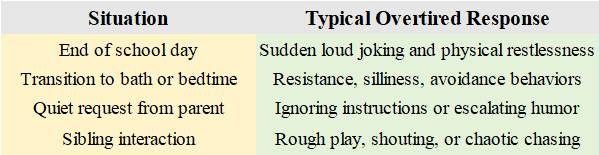
How Parents Commonly Misread the Behavior?
One of the core difficulties is that overtiredness does not resemble conventional sleepiness. Adults expect fatigue to look like slowing down, yawning, or seeking rest. Children frequently present the opposite pattern.
1. “They’re being silly on purpose”
Because the behavior is loud and attention-seeking, parents often assume intentional disruption. In reality, reduced self-regulation means the child cannot easily inhibit impulses or shift into calm states.
2. “They aren’t tired yet”
The “second wind” effect often leads caregivers to believe bedtime should be delayed. However, this phase typically occurs after optimal sleep readiness has already passed.

3. “This needs stronger discipline”
When exhaustion is mistaken for misbehavior, responses tend to escalate—more warnings, more consequences, more verbal correction. Unfortunately, an overtired brain processes less verbal instruction and responds poorly to complex reasoning.
Signs Your Child May Be Entering the Overtired Zone
Here are common patterns many parents overlook:
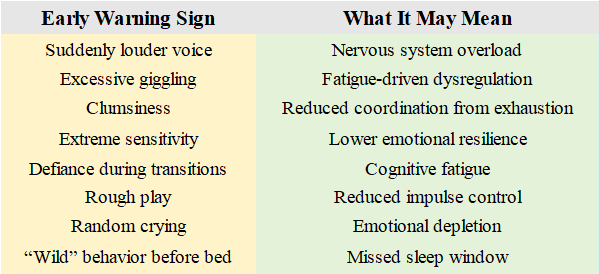
Recognizing these signals early is often more useful than reacting after the meltdown fully develops.
The Difference Between Playful and Dysregulated
Not all silliness is a problem. Healthy playful behavior is flexible. Dysregulated overtired behavior becomes intense, repetitive, and difficult to stop.
Here is a useful comparison:
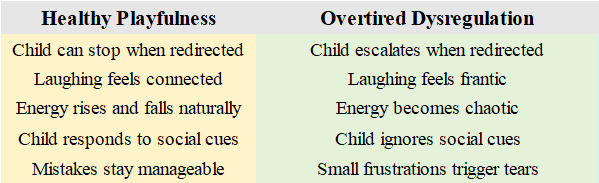
Parents often sense this difference instinctively. Many describe the behavior as “too much” or “out of control.” That feeling matters.
A More Effective Parent Response
When parents interpret overtired silliness as deliberate misbehavior, they often respond with:
● More lectures
● More warnings
● Raised voices
● Longer discipline conversations
Unfortunately, exhausted children typically process less information effectively. That does not mean boundaries disappear. It means the strategy changes. Compare these approaches:
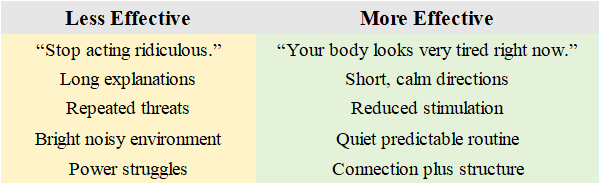
Many parents notice dramatic improvement simply by moving bedtime earlier by 20–40 minutes.
What Actually Helps
When overtiredness is the underlying driver, behavioral escalation strategies are usually ineffective. What tends to work better is environmental and physiological adjustment:
1. Start the slowdown earlier than bedtime
By the time overtired silliness appears, the child has often already passed their optimal sleep window. That means the most effective intervention is prevention, not reaction.
Evening routines work best when the entire household rhythm gradually shifts downward in intensity well before bedtime. This might involve reducing active play after dinner, avoiding highly stimulating games, and limiting unpredictable transitions in the last couple of hours of the day. The goal is not to abruptly stop activity but to progressively lower arousal so the child’s nervous system has time to transition.
When this “slow landing” is missing, children often enter a dysregulated phase that looks like hyperactivity or excessive silliness, even though it is actually fatigue.

2. Protect a predictable wind-down sequence
A consistent wind-down routine acts as a cue that sleep is approaching, which reduces resistance and uncertainty. What matters most is repetition and predictability rather than how elaborate the routine is.
When the sequence stays the same each night, children do not need to make decisions or adjust to new expectations while already tired. This reduces cognitive load and emotional friction. Dimmer lighting, quieter voices, and slower pacing from adults further reinforce the transition.
Inconsistent or rushed routines tend to increase stimulation at the exact moment the child needs downregulation, which often leads to more silliness, avoidance, or emotional reactivity.
3. Simplify communication to single-step directions
Overtired children struggle with working memory and multi-step processing. Long explanations or chained instructions often fail because the child cannot hold all the information at once, not because they are refusing.
In these moments, shorter and simpler communication is more effective. One instruction at a time reduces cognitive demand and lowers the chance of escalation. Tone also matters; calm, neutral delivery tends to work better than repeated reminders or increasingly urgent language.

When necessary, proximity can replace verbosity—being physically present and guiding the next small step is often more effective than repeating instructions from a distance.
4. Reduce stimulation instead of trying to “burn energy off”
A common misunderstanding is assuming that overtired children need more activity to exhaust them. In reality, additional stimulation in a fatigued state often increases dysregulation.
Instead of high-energy play, what tends to help is lowering sensory input. Quieter activities, softer lighting, reduced background noise, and calm shared routines all help signal safety and rest. Even positive excitement can be too activating late in the day when the nervous system is already near overload.
The goal is not to drain energy further but to reduce incoming stimulation so the system can settle.
5. Move bedtime earlier in small, flexible adjustments
Many evening behavior challenges are linked to children consistently going to bed slightly later than their biological sleep readiness window. Once overtiredness sets in, sleep becomes more difficult rather than easier, even if the child appears energetic.
Small adjustments—often in the range of 15 to 30 minutes earlier—can make a meaningful difference. These adjustments work best when guided by behavior patterns rather than the clock alone. If silliness, emotional sensitivity, or restlessness reliably appears at a certain time, that is often a sign the sleep window has already been missed. Earlier timing is not about strict schedules; it is about aligning sleep opportunity with biological readiness.
(This article is intended for educational and informational purposes only and should not replace professional medical, psychological, or developmental advice. Persistent sleep problems, severe behavioral concerns, or ongoing emotional difficulties should be discussed with a licensed pediatrician or qualified child development professional.)
FAQs
1. Can overtired children really look hyper instead of sleepy?
Yes. Many children become louder, sillier, more impulsive, or emotionally reactive when overtired because stress hormones temporarily increase alertness.
2. Does an earlier bedtime actually help behavior?
For many children, yes. Even small bedtime adjustments can improve emotional regulation, transitions, and evening cooperation when fatigue is a major factor.
3. How can parents tell the difference between misbehavior and exhaustion?
Patterns matter. If difficult behavior regularly appears late in the day, after busy schedules, skipped naps, or overstimulation, fatigue may be playing a significant role.
About Author
Arden Vale is a fictional parenting writer and former early childhood education consultant who focuses on emotional regulation, sleep-related behavior, and realistic family routines. Her work centers on translating child development research into practical strategies that parents can use in everyday life, especially during high-stress moments such as bedtime, school transitions, and emotional meltdowns.
References
Cleveland Clinic. (2022). Signs your child may be exhausted.
ParentMap. (2022). 10 surprising ways overtiredness harms children.
ScienceDaily. (2021). Children’s expressions tell the story of poor sleep.
Stay awhile and explore more parenting insights on this blog designed to make everyday family challenges feel more manageable and understandable.