
May 26, 2026
Key Points:
● Highly structured school days can overload a child’s self-regulation system.
● “Defiance” at home is often emotional decompression, not intentional misbehavior.
● Mental fatigue, masking, and sensory strain build up across the school day.
● Structured environments can reduce control capacity, not increase cooperation.

Estimated Reading Time: 11 minutes┃Post By Dr. Evelyn Hartwell
A child who follows rules all day at school, complies with instructions, and receives positive behavior reports can sometimes transform the moment they walk through the front door—arguing over simple requests, refusing to cooperate, or reacting strongly to minor frustrations like a misplaced backpack or an unfinished snack. For many parents, this shift feels confusing: if the child can behave appropriately for six to eight hours in a structured environment, why does defiance appear at home?
This pattern is widely recognized in child psychology and is often linked to what clinicians describe as post-school emotional “restraint collapse,” where children release accumulated stress after sustained self-control demands throughout the day . Importantly, what looks like defiance is frequently not oppositional intent but nervous system overload following prolonged regulation effort .
To understand this phenomenon clearly, it is necessary to examine what structured school environments actually require from children—and what happens when those demands exceed a child’s regulatory capacity.
What “Highly Structured School Days” Actually Demand From Children
A structured school environment is not just “organized.” From a child’s neurocognitive perspective, it is a continuous sequence of demands requiring sustained executive functioning. Core demands placed on children during school:
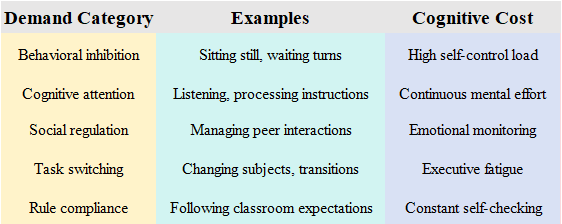
A typical school day requires children to regulate behavior across all these domains simultaneously. This is particularly taxing for children with developing executive functioning skills, ADHD traits, anxiety tendencies, or sensory sensitivity profiles.
Even when a child appears “well-behaved,” that behavior may reflect sustained self-monitoring rather than internal ease.
Why Behavior Changes at Home?
Self-Regulation Depletion
One of the most consistent findings in developmental psychology is that self-control is a finite resource. When children spend all day regulating attention, impulses, and emotions, they experience a gradual depletion of cognitive resources.
By the end of the school day:
● Attention becomes fragile
● Frustration tolerance drops
● Emotional thresholds lower
● Transitions feel overwhelming
This is why the same child who tolerated a noisy classroom in the morning may become distressed by a simple instruction like “please put your shoes away” at 4:30 PM. It is not selective defiance. It is reduced capacity.
Restraint Collapse
The home environment is typically the first place where children feel psychologically safe enough to release accumulated tension.

In restraint collapse, children may exhibit:
● Sudden irritability
● Crying over small frustrations
● Refusal to follow directions
● Physical agitation or silliness
● Withdrawal or shutdown
This pattern occurs because children have spent the entire day suppressing impulses and managing expectations. Once the external demands stop, the internal pressure releases at once .
A helpful analogy is holding a heavy backpack all day: the moment it is removed, muscles relax—but that relaxation can look unsteady or even clumsy.
Why Structured Days Can Increase “Defiant-Looking” Behavior
At first glance, structure should reduce behavioral problems. However, excessive or rigid structure can produce the opposite effect in some children. Key mechanisms include:
Over-Control of Autonomy
Children naturally seek control over small aspects of their environment. Highly structured days often limit autonomy across nearly every hour.
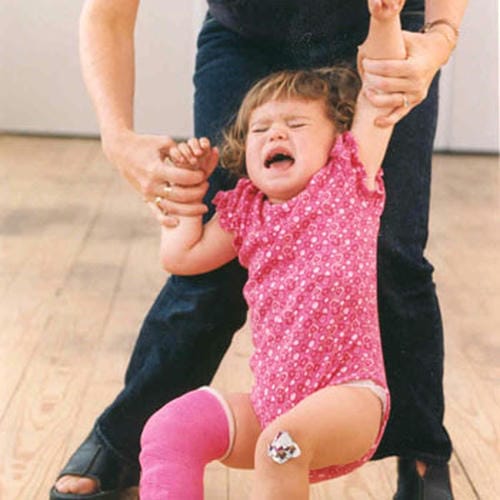
When children experience prolonged lack of control, the nervous system may “reclaim” control at home through refusal, argument, or emotional outbursts.
Emotional Masking at School
Many children learn to “mask” their stress—appearing calm and compliant while internally struggling. This is especially common in anxious, sensitive, or neurodivergent children .
Masking is metabolically expensive. It requires continuous suppression of internal states.
Transition Shock
The shift from structured school environment → unstructured home environment is abrupt. The nervous system must rapidly reorient, which can trigger dysregulation.
Delayed Hunger and Fatigue Effects
Children often delay hunger cues during school. By the time they get home:
● Blood sugar is lower
● Physical fatigue is higher
● Sensory overload has accumulated
All of these factors reduce frustration tolerance.
Real-World Scenario: What This Looks Like in a Typical Family
Consider this common sequence:
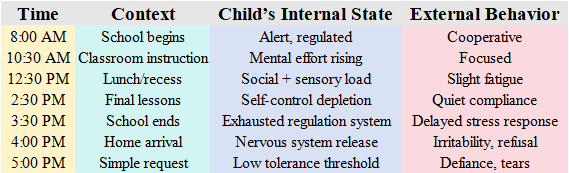
From the outside, parents often see only the last two rows. From the inside, the child has already “spent” their regulatory capacity long before arriving home.
A child who falls apart at home after a structured school day is often not showing “worse behavior.” They are showing unmasked behavior.
The school day requires children to function under sustained external regulation. Home is where internal regulation reappears—often in raw, unfiltered form.
What looks like defiance is frequently the endpoint of a long day of compliance, effort, and emotional control.
What Actually Helps (Practically, Not Theoretically)
Effective responses focus on reducing demand immediately after school and restoring regulation capacity.
A. Decompression Window (Critical)
A 20–60 minute buffer after school where:
● No homework
● No questioning about the day
● Minimal verbal demands
B. Physiological Stabilizers
These address the body first, not behavior:
● Protein-based snack
● Water intake
● Quiet physical movement (walking, bouncing, stretching)
C. Low-Pressure Connection
Instead of direct questioning:
● Sit nearby
● Offer presence without interrogation
● Allow child-led interaction
D. Reduced Transition Load
Avoid stacking demands immediately after school:
● “Shoes, homework, chores” in rapid sequence increases overload
● Spacing tasks reduces escalation risk
(This article is for informational purposes only and does not constitute medical, psychological, or behavioral diagnosis or treatment advice. If you are concerned about your child’s emotional or behavioral patterns, consult a qualified pediatrician, psychologist, or licensed mental health professional.)
FAQs
1. Does this mean I should ignore defiant behavior after school?
No. It means responding first to regulation needs (food, rest, quiet) before attempting behavioral correction.
2. Is this only common in neurodivergent children?
No. While more pronounced in ADHD, autism, or anxiety profiles, it can occur in any child under sustained cognitive load.
3. How long should after-school decompression last?
Typically 20–60 minutes, but some children require longer depending on age, workload, and temperament.
References
Institute of Child Psychology. (2025). Why some kids fall apart after school and what helps.
Ballantyne Psychology. (2025). Why kids melt down after school.
Melbourne Children’s Psychology Clinic. (2025). When children fall apart after school: Understanding causes.