
June 4, 2026
Key Takeaways
● Even a one- or two-hour weekend bedtime shift can disrupt a child’s internal sleep rhythm.
● Many children sleep worse on Sunday nights after irregular weekend routines.
● Sleeping in late rarely “fixes” sleep debt for young kids the way parents expect.
● Inconsistent weekend wake times often create Monday morning meltdowns and behavioral issues.
● Small schedule adjustments are usually more effective than dramatic sleep “resets.”

Estimated Reading Time: 11 minutes┃Post By Robin Everly
Saturday night feels harmless. Dinner runs late because grandparents visit. A movie stretches longer than expected. Pajamas happen at 9:15 instead of 7:45. Parents shrug because “it’s the weekend.” The child sleeps in Sunday morning, everyone enjoys a slower pace, and the household feels relaxed for once.
Then Monday arrives. The child who normally wakes at 6:45 suddenly cannot get out of bed. Breakfast becomes a negotiation. Shoes take fifteen minutes. Tears appear over the “wrong spoon.” By afternoon, teachers mention irritability, emotional outbursts, or trouble focusing.
Most parents never connect those Monday struggles to the weekend schedule shift that caused them. The problem is not usually one dramatic late night. The problem is the repeated pattern of changing sleep timing every Friday and trying to reverse it every Sunday evening. Over time, children begin living in two different time zones each week: “school-week time” and “weekend time.” Sleep researchers often compare this phenomenon to a mild form of jet lag sometimes called “social jetlag.” Irregular schedules disrupt circadian rhythm stability — the body’s internal timing system that regulates sleep, alertness, hormones, and energy levels. Parents usually notice the symptoms long before they notice the cause.
What Weekend Sleep Drift Actually Looks Like
Many families assume they maintain “pretty consistent” schedules. But when the actual numbers are written down, the difference becomes obvious. Here is a realistic example from a typical family with a 6-year-old child:
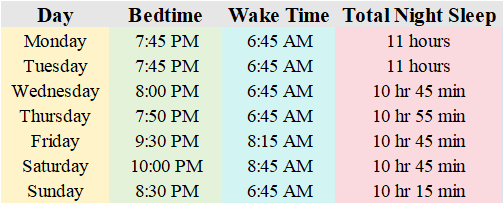
On paper, the child still appears to get “enough” sleep. But the timing is unstable. The child’s brain now receives conflicting signals about when melatonin should rise, when the body should prepare for rest, and when morning alertness should begin. Children are especially sensitive to these shifts because their circadian systems are still developing.
Why Sleeping In Does Not Always Help
Parents often believe weekend sleep-ins compensate for weekday exhaustion. Sometimes they do temporarily reduce accumulated fatigue. But large sleep timing shifts frequently create a different problem: the child is no longer sleepy at the usual Sunday bedtime.
A child who normally wakes at 6:45 AM but sleeps until 9:00 AM on Saturday and Sunday may simply not feel biologically ready for sleep at 7:45 PM Sunday night. Parents then experience familiar scenes:
● The child repeatedly leaves the bedroom.
● Bedtime suddenly takes 90 minutes.
● The child claims they are “not tired.”
● Night wakings increase.
● Monday morning becomes miserable.
This surprises many parents because the child technically spent more time in bed. But sleep quality and sleep timing are interconnected.

The Hidden Behavioral Effects Parents Misread
One of the most frustrating parts of weekend sleep disruption is that children rarely look traditionally “tired.” Instead, they often appear:
● hyperactive
● emotional
● silly
● argumentative
● unusually sensitive
● physically restless
A 5-year-old may sprint through the hallway screaming after a late weekend bedtime while parents assume the child has “extra energy.” In reality, overtired children frequently become dysregulated rather than sleepy-looking.
Here is a common real-world pattern:
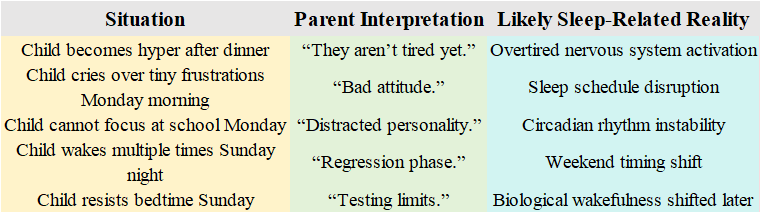
This is one reason sleep problems are frequently underestimated. The symptoms often masquerade as behavioral or emotional issues.
Weekend Activities Quietly Push Sleep Later
Most schedule drift does not happen intentionally. It develops through ordinary family routines.
Common Weekend Sleep Disruptors
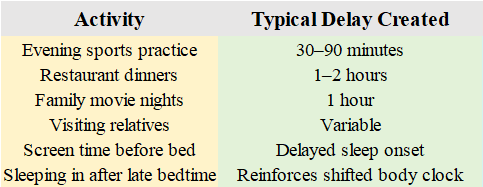
The issue is cumulative inconsistency rather than isolated events. A single late birthday party usually will not destroy sleep patterns. But repeated weekend schedule swings gradually train the body to expect different sleep timing every few days.
Why Sunday Nights Are Usually the Worst
Sunday night problems frustrate parents because they seem irrational. The child appeared exhausted all day but suddenly becomes fully alert at bedtime.
If a child wakes two hours later than usual on both Saturday and Sunday, their biological “clock” shifts later.
By Sunday evening:
● melatonin release may begin later
● the brain may not recognize normal bedtime as sleep time
● the child may experience reduced sleep pressure
Parents then attempt to force an earlier bedtime because school starts Monday. The result becomes a nightly battle neither side understands.

The “Catch-Up Sleep” Trap
Parents are often exhausted themselves. Weekend flexibility feels emotionally necessary.
The temptation is understandable: “We all need extra rest.”
But children do not recover from inconsistent sleep schedules the same way adults imagine. For younger children especially, consistency tends to matter more than dramatic recovery sleep.
A realistic goal is not perfection. A realistic goal is reducing extreme differences.
What Sleep Consistency Actually Means
Many parents think consistency means military-level precision. It does not.
Most pediatric sleep specialists consider moderate variation normal.
A practical target looks more like this:
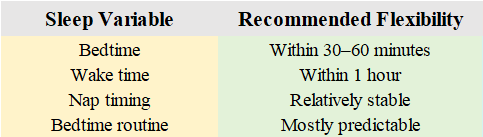
The family does not need to cancel every social event. The goal is avoiding constant two- or three-hour swings.
Signs Weekend Sleep Drift Is Affecting Your Child
Some clues are subtle. Others are obvious.
Common Indicators
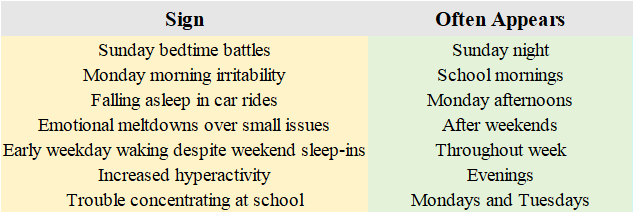
Parents often spend months adjusting discipline strategies before realizing the underlying issue is sleep timing instability.
What Actually Helps?
Families usually succeed when they make small, sustainable adjustments instead of extreme rules.
1. Protect Wake Time More Than Bedtime
A consistent wake-up time strongly supports circadian rhythm stability. A child waking at 7:00 AM daily usually stabilizes faster than a child with wildly changing mornings.
2. Limit Weekend Sleep-Ins
Try avoiding more than about one extra hour of morning sleep whenever possible.
3. Keep the Bedtime Routine Predictable
Even if bedtime shifts slightly: bath, pajamas, books, lights out should remain recognizable. Consistency signals safety and sleep readiness.
4. Reduce Bright Screens Before Bed
Weekend movie marathons immediately before bed can delay sleep onset significantly for some children.
5. Shift Back Gradually After Busy Weekends
If bedtime drifted later Saturday, avoid attempting a dramatic two-hour reset Sunday night. Instead: wake slightly earlier Sunday morning, increase daytime sunlight exposure, and return toward normal bedtime gradually.
Why Parents Blame Themselves Unnecessarily
Many parents interpret sleep disruption as personal failure. They assume they lack discipline, their child is uniquely difficult, or routines “do not work” for their family.

Usually the issue is simpler. Children’s biological clocks respond strongly to timing consistency. Even loving, attentive parents unknowingly disrupt that rhythm through ordinary weekend habits. The problem is structural, not moral.
The Most Important Thing Parents Miss
Children do not experience weekends the same way adults do. Adults often enjoy irregular schedules because flexibility feels restorative psychologically. Children, especially younger ones, usually feel safest and function best with predictability.
That predictability supports emotional regulation, learning, mood stability, attention, physical recovery, and easier bedtimes.
This does not mean weekends must become rigid. It means children’s nervous systems benefit when weekends still resemble normal life instead of becoming an entirely different schedule.
Small Changes Usually Work Better Than Extreme Ones
Parents sometimes react to sleep struggles by implementing aggressive plans: eliminating all flexibility, enforcing extremely early bedtimes, removing every social activity, or introducing complicated sleep “hacks.”
Most families do not need dramatic interventions. Often, the most effective change is surprisingly boring: keeping wake-up times reasonably consistent.
That single adjustment stabilizes many downstream sleep problems because the body begins relearning when to feel tired naturally. The quiet damage of weekend schedule changes is not usually immediate. It accumulates slowly. And because it accumulates gradually, parents often miss the connection entirely.
(This article is intended for informational and educational purposes only and should not replace professional pediatric or medical advice. Sleep needs vary by child, age, temperament, and health status. Parents concerned about chronic sleep difficulties, breathing issues during sleep, or persistent behavioral changes should consult a licensed healthcare professional.)
FAQs
1. Is it harmful if my child stays up late only once in a while?
Occasional late nights are usually manageable.
Problems typically develop when late bedtimes and large sleep-ins happen repeatedly every weekend.
2. Should I let my child sleep in after a terrible night of sleep?
A small amount of extra sleep may help, but extremely late wake times often make the next bedtime harder.
3. My child wakes early even after going to bed late. Why?
The child’s circadian rhythm may still be anchored to the usual wake-up time.
Children often cannot suddenly “sleep in” the way adults expect.
About Author
Robin Everly is a fictional parenting writer and former family support coordinator who focuses on child routines, emotional regulation, and household stress patterns.
Her work centers on translating sleep research and developmental psychology into realistic guidance for busy families managing everyday parenting challenges.
References
Acebo, C., Sadeh, A., Seifer, R., Tzischinsky, O., Hafer, A., & Carskadon, M. A. (2013). Norms and trends of sleep time among US children and adolescents. Sleep Medicine, 14(1), 24–29.
Verywell Health. (2023). Why you should keep a consistent bedtime every night.
TIME. (2026). The 1 small change that can reset your sleep.
Health.com. (2023). What is circadian rhythm?